Muse vs Claude, Gemini & Grok
Claude, Gemini and Grok are frontier assistants — superb thinkers with growing agentic features. Muse is the opposite bet: a narrower product that acts on your inbox, calendar and wallet. Here is the honest scorecard.
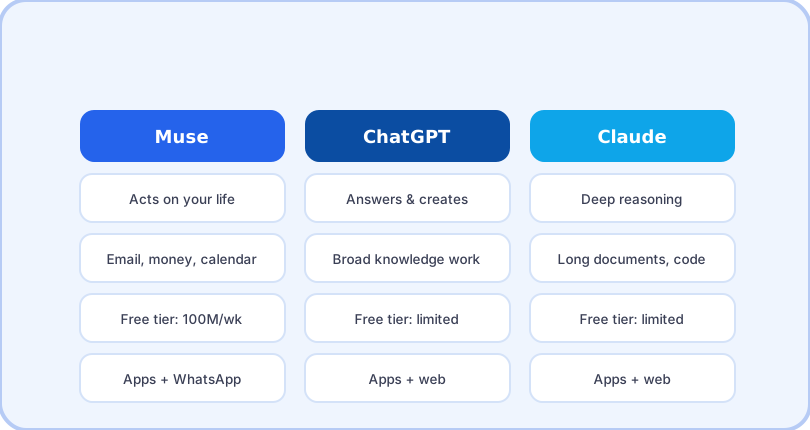
The honest scorecard
| Dimension | Muse | Claude | Gemini | Grok |
|---|---|---|---|---|
| Superpower | Executing errands across your services | Deep reasoning, long documents, code | Google-app integration, multimodal | Real-time info, personality |
| Your inbox/calendar | Core wiring — the product | Via integrations/tooling | Native in Google ecosystem | Limited |
| Acts without supervision | The design goal | Agentic features, dev-oriented | Assistant features | Assistant features |
| Ecosystem maturity | New (Sept 2026) | Mature | Mature | Younger |
| Paid shape | $20 / $100 usage tiers | ~$20 Pro and up | ~$20 and up | ~$8–30 tiers |
Reads on each
vs Claude: Claude is the reasoning benchmark many professionals default to, and its agentic tooling is developer-grade. It will not chase your Thursday scheduling thread; Muse will. If your day is documents and code, Claude; if it is logistics, Muse.
vs Gemini: The most direct rivalry. If your life already runs on Gmail and Google Calendar, Gemini's native integration covers part of Muse's territory — though Muse's cross-service execution (payments, shopping, health together) is the broader product. Google-ecosystem households should trial both before paying either.
vs Grok: Grok competes on real-time information and tone, not errands. Different aisle entirely.
The sixty-second picker
| Your week is mostly… | Reach for |
|---|---|
| Errands: schedules, inboxes, renewals, baskets | Muse — execution is the product |
| Documents, long code, hard analysis | Claude — reasoning depth |
| Life inside Gmail/Calendar/Workspace | Gemini — native integration |
| Real-time chatter and breaking news | Grok — its home turf |
The bet you are making
Choosing Muse means betting that delegated execution beats better answers for your daily hours — that the inbox zero and the booked appointments are worth more than a smarter essay. It is also a bet on Meta as a steward of your most personal data. Both bets are legitimate; just make them with eyes open, start on the free tier, and keep a general assistant for the thinking Muse does not do.
One more axis for technical readers: the open-source world runs its own agents — on your machine, with any model, wired to whatever you dare. Our Hermes Agent guide covers that route. And a closing caveat that applies to every cell in the table above: these products iterate monthly, and a comparison printed in October ages like milk by January — we re-date pages when reality moves, so check the as-of line before you buy.
Frequently asked questions
Is Claude an agent like Muse?
Claude is a frontier assistant with agentic features and a developer ecosystem; Muse is a consumer agent wired to your services. Claude can do agentic work via tooling; Muse does errands as the product.
What about Gemini?
Gemini is Google's assistant line — deep integration with Google apps (Gmail, Calendar) makes it the closest rival to Muse's errand territory inside the Google ecosystem.
Which is cheapest?
Different shapes: Muse has an unusually large free tier (with a card on file) and $20/$100 paid headroom; Claude and Gemini have free tiers plus ~$20 paid plans, with premium tiers above.